Common Pitfalls and How to Avoid Them
Search “Chinese character tattoo fail” and you’ll find the same handful of stories recycled endlessly: the guy who wanted “strength” and got a character that just means “big,” the woman whose “sister” tattoo reads as something closer to “female donkey” once you account for a wrong radical, the mirrored design that isn’t actually a character at all. These stories get repeated because they’re funny, but they point to a real pattern worth understanding before you commit ink to skin.
Chinese characters make appealing tattoos for reasons that have nothing to do with novelty. A single character can carry the semantic weight of an entire English sentence, which is exactly what you want on a wrist or a ribcage where space is limited. Brush-stroke calligraphy also has a sculptural quality that alphabetic scripts rarely achieve. But that same compression – one symbol doing the work of several English words – is precisely what makes small errors so visible. There’s nowhere to hide a mistake in three strokes.
The Part Most Tattoo Guides Skip Over
Two things about how Chinese writing works trip people up more than anything else.
First, Chinese isn’t built the way English is. You can’t treat characters like letters and string together a phonetic spelling of an English word – that’s not how the writing system functions, and doing so usually produces something a native reader can’t parse as language at all, closer to random noise than a sentence.
Second, and this is the one that catches even careful people off guard: plenty of characters that read as clean, self-contained concepts in a dictionary or a translation app actually sound incomplete or strange standing alone. Chinese meaning leans heavily on context and pairing. A character that’s perfectly natural inside a two-character word can look truncated by itself – imagine tattooing just the “de” from “determined” and expecting a stranger to read “determination.”
There’s also the Simplified-versus-Traditional split. Mainland China uses Simplified characters; Taiwan, Hong Kong, and a lot of overseas communities use Traditional. Some characters are shared between the two systems, others aren’t, and a design that mixes them – one Simplified stroke here, one Traditional stroke there – is an immediate tell to anyone who reads the language that the source wasn’t reliable.
Characters People Actually Request, and Where the Nuance Lives
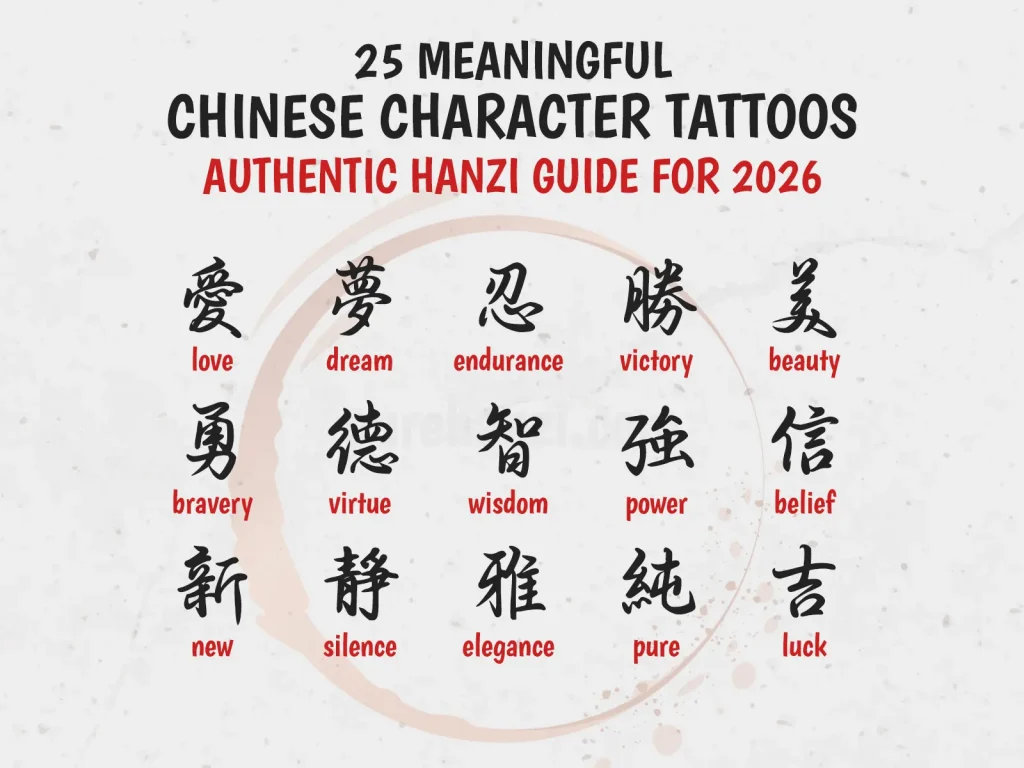
| Character | Pinyin | What people usually want | What’s actually going on |
|---|---|---|---|
| 愛 | ài | Love | Holds up fine alone, though it’s more often seen as part of a compound – 愛情 for romantic love, 熱愛 for a deeper passion. |
| 力 | lì | Strength / Power | Alone, this leans mechanical – physical force, raw power. 力量 (lìliàng) is the closer match for the “inner strength” most people actually mean. |
| 義 | yì | Justice | Sits closer to “righteousness” or moral duty than the legal concept of justice. 正義 (zhèngyì) is the better fit if courtroom-style justice is the intent. |
| 勇 | yǒng | Courage | Reads cleanly on its own, though 勇氣 (yǒngqì) is the fuller, more natural word choice. |
| 福 | fú | Fortune / Blessing | One of the few single characters that genuinely functions as a standalone symbol in Chinese culture – it’s displayed on doors during Lunar New Year for exactly this reason. |
| 忍 | rěn | Patience | Frequently requested, but its core sense leans toward “endure” or “tolerate,” including enduring something unpleasant. Not the purely positive, Zen-adjacent “patience” people usually picture. |
| 夢 | mèng | Dream | Reads correctly as a noun – a dream you have, an aspiration. It won’t carry a full sentence like “chase your dreams” on its own. |
Treat this table as a starting point for a conversation with a translator, not a menu to pick from directly.
Where These Tattoos Actually Go Wrong
Phrases translated word-by-word. English idioms like “live, laugh, love” or “only God can judge me” don’t have a direct character-for-character equivalent. Run through a basic translator, they often come back as a string of characters with no coherent grammar – technically “translated,” not actually meaningful.
Reading order gets flipped. Traditional layouts can run top-to-bottom, and some older or decorative arrangements read right-to-left. A design lifted from a reference image without understanding its original orientation sometimes ends up printed backward.
Mirrored or “stylized” characters that stop being characters. Hanzi aren’t symmetrical the way some scripts are. Flip one for a design reason and you often get something that resembles a character to someone who can’t read Chinese, and resembles nothing to someone who can.
Simplified and Traditional mixed in one design. This is the error that native readers spot instantly and non-readers never catch – different strokes from different systems sitting side by side in what’s supposed to be a single word.
A character chosen because it looks good, not because it stands alone. Some characters exist almost exclusively as part of longer words. Isolated, they read as either meaningless or unintentionally funny to someone fluent – not dissimilar to how “un-” tattooed by itself wouldn’t mean “not.”
Ornamental scripts that sacrifice legibility. Certain seal-script or highly stylized calligraphic renderings distort strokes enough that even native readers unfamiliar with that specific script tradition struggle to identify the character. If being read correctly matters to you, standard regular script (楷書, kǎishū) is the safer choice over something decorative.
What Actually Prevents This
There isn’t one silver-bullet source. The design that holds up is usually the one checked by more than one person who didn’t produce the design in the first place.
That means: a native speaker confirming the character reads naturally and means what you intend in context, not just in a dictionary entry. A professional translator for anything longer than a single word, since phrase-level grammar is where automated tools fail hardest. A word-level dictionary check – not just a character-level one – to confirm the character actually functions on its own. And ideally, a second opinion from someone who wasn’t involved in producing the first translation, because it’s easy for one source’s blind spot to go unnoticed by that same source.
If you’re getting a phrase rather than a single character, ask specifically whether it reads as natural Chinese sentence structure or as an English sentence translated piece by piece. Those are very different outcomes, and the difference isn’t obvious to someone who can’t read the result.
The Actual Takeaway
The character itself is deceptively simple – a handful of clean strokes, easy to admire as pure design. That’s exactly why the translation step deserves the same seriousness as the artwork. A tattoo artist can execute a beautiful rendering of the wrong word just as easily as the right one; the ink doesn’t know the difference. Treating the linguistic step with real scrutiny, rather than trusting whatever produced the first draft, is what separates a tattoo that reads correctly for the next fifty years from one that becomes an anecdote you have to explain.
Frequently Asked Questions
Is it okay to get a single Chinese character as a tattoo, or should it always be a full word?
It depends on the character. Some, like 福 (fortune/blessing), genuinely function as standalone symbols in Chinese culture. Others only make sense as part of a two-character word and will read as incomplete or odd by themselves – a native speaker or translator can tell you which category a given character falls into.
Should I choose Simplified or Traditional Chinese characters?
Simplified is standard in mainland China; Traditional is standard in Taiwan and Hong Kong. Pick one and make sure every character in the design matches that system – mixing the two within a single word is one of the most common tattoo errors.
Can I trust a translation app for a tattoo?
Not on its own, especially for full phrases. Translation apps handle single common words reasonably well but frequently fail at idioms and sentence-level grammar, producing strings of characters that don’t read as coherent Chinese. Have any app-generated translation reviewed by a native speaker or professional translator before it’s permanent.
Does a mirrored or flipped Chinese character still mean the same thing?
Usually not. Chinese characters aren’t symmetrical, so flipping one for a design effect often produces something that isn’t a valid character at all – it just resembles one to someone unfamiliar with the script.